Showing posts with label SAHRA. Show all posts

Monday, 24 June 2024

South Africa: Susan Pardew, Hampton Court, Jimmy le Roux, Kilfenora & Spiffero shipwrecks

SAHRA Maritime and Underwater Cultural Heritage

Karimona shipwreck in Namibia

April 28:

“This day in our shipwreck and aeronautical wreck history”

1872: Susan Pardew, this wooden British barque wrecked in Mossel Bay between the Great Brak River and the town of Mossel Bay in the Western Cape.

1881: Hampton Court, this vessel started leaking at sea west of East London but arrived at Cape Town in the Western Cape on the 27th where it was condemned the next day (on this day).

1938: Jimmy le Roux, this motor-powered fishing vessel wrecked on Dyer Island in the Western Cape.

1940: Kilfenora, this South African tanker was lost after its mooring lines broke during a south-easterly gale. It ran aground on Schaapen Island in Saldanha Bay in the Western Cape and became a wreck. In 1974 it was removed as it was a shipping hazard.

1984: Spiffero, this yacht was the last vessel to be claimed by the strong winds and rough seas of the Vasco da Gama race to East London. In the early hours of the morning of the 27th it rolled and was extensively damaged, with almost the entire top deck being destroyed. A May Day radio signal was sent via a jerry-rigged radio and was heard by a nearby vessel, the Libreville. It was found just before nightfall on the 28th by a ‘Kuswag’ vessel. Although it was being towed back, the Spiffero sank because of the damage it had sustained. The ‘Kuswag’ vessel that had left to fetch it had to be towed into East London by another ‘Kuswag’ vessel because of sustaining damage whilst bumping into the Spiffero whilst towing it in the rough seas.

Purchase photo/4K video: portfolio1 portfolio2
Aerial photo/video service/inquiries: info@traveltonamibia.com
Telegram: ExploringNamibia

Sunday, 23 June 2024

South Africa: Derby, Jacaranda, Cape of Good Hope & Sensation shipwrecks

SAHRA Maritime and Underwater Cultural Heritage

April 27:

“This day in our shipwreck and aeronautical wreck history”

1895: Derby, this wooden Norwegian barque wrecked between Oyster Bay and Cape St Franics in the Eastern Cape. It sprang a leak in heavy weather and its pumps were not functional. The crew insisted that it be beached as they were exhausted from manually moving the water. It was beached at Thys Bay and became a total wreck. Four of the crew returned to the vessel to salvage some goods and drowned.

The Derby (1895) being worked on in a dry dock, location and date unknown

1967: Jacaranda, this motor-powered South African fishing vessel got stuck on the bar of the Breede River mouth in the Western Cape and wrecked.

1984: During the Vasco da Gama race to East London, a 60 knot westerly started blowing on the 26th. It continued into the 27th and claimed two further vessels on this day:

• Cape of Good Hope, this yacht was struck by a wave which rolled it and led to it foundering within 8 minutes. All on board made it to the life raft and were rescued by a SAAF helicopter.

The Sensation (1984) lying battered on the rocks at the Daza River mouth after being flung high and dry by the powerful waves

• Sensation, this yacht tacked close to the shore and with both sail and motor running, could not make against the powerful waves. Eventually the waves threw it onto the rocks by the Daza River mouth, just north of the Msikaba River mouth in the Eastern Cape.

Purchase photo/4K video: portfolio1 portfolio2
Aerial photo/video service/inquiries: info@traveltonamibia.com
Telegram: ExploringNamibia

Friday, 31 May 2024

South Africa: Africaine, Johanna, Martha, Waterloo, Fleur de Mourice, Mexican, Ashmount & Aloe shipwrecks

SAHRA Maritime and Underwater Cultural Heritage

April 5:

“This day in our shipwreck and aeronautical wreck history”

1841: Africaine, this wooden sailing schooner wrecked on the rocks on East Beach, about 1 km east of the Kowie River Mouth in Port Alfred in the Eastern Cape.

1848: A south-easterly gale in the Eastern Cape claimed three vessels on this day:

• Johanna, this wooden sailing barque’s cables parted, and it subsequently wrecked in Port Elizabeth in Algoa Bay.

• Martha, this wooden sailing barque wrecked in Port Elizabeth in Algoa Bay. All on board the Johanna and Martha were saved by the Port Elizabeth lifeboat.

• Waterloo, this iron sailing schooner (coaster) wrecked just north of the Great Fish river mouth after offloading supplies at Port Jessie in what was named Cawood/Waterloo Bay. The master and second mate drowned during the wrecking and the loss precipitated the abandonment of the port.

1894: Fleur de Mourice, this vessel struck the bar in Durban harbour in KwaZulu-Natal whilst being towed on this day. It was officially condemned on the 14th of April.

1900: Mexican, this British steam-powered passenger ship left Table Bay on the 4th April transporting 244 passengers and a cargo of mail. It collided with the troop transport ship Winkfield in thick fog, about 65 kilometres north of Dassen Island, late at night on the 5th.

The Mexican (1900) in Table Bay in 1883

All on board were rescued by the Winkfield, and its cargo of mail by the Montrose. By the time the Winkfield left, the Mexican had disappeared below water. The Mexican was the first loss of the newly formed Union-Castle line.

1905: Ashmount, this steel steam-powered cargo ship struck a rock between Fish Point and Stalwart Point and subsequently wrecked in Waterloo Bay in the Eastern Cape. One of the lifeboats capsized in the surf whilst trying to land at Three Sister’s Rocks near the Kowie River mouth which resulted in the loss of seven (possibly eight) lives.

1943: Aloe, this British steam-powered merchant ship was torpedoed and sunk by U-182 off Port Shepstone in KwaZulu-Natal. The 46 that were on board were picked up by the Alexander Ramsey and landed at Cape Town.

The Aloe (1943), date and location unknown

The master was however taken as prisoner on board the U-boat and presumed to have died when U-182 was attacked and sunk on the 16th of May off Madeira.

Purchase photo/4K video: portfolio1 portfolio2
Aerial photo/video service/inquiries: info@traveltonamibia.com
Telegram: ExploringNamibia

Friday, 10 May 2024

South Africa: The Haerlem, Primmo Janetto, Susan, Blackaller, Jim Crow, Frances Bain, Wasp, Waif, Jan van Riebeeck shipwrecks

SAHRA Maritime and Underwater Cultural Heritage

March 25:

“This day in our shipwreck and aeronautical wreck history”

1647: The Haerlem (Haarlem), this Dutch East Indiaman wrecked on Milnerton Beach in Table Bay in the Western Cape. It was on a homeward bound journey with two other VOC vessels, the Olifant and the Schiedam, when sight of them was lost before entering Table Bay. After seeing an unfamiliar ship in its normal anchoring spot, the captain sent men by boat to investigate, but before they could return, a sudden south-easterly gale resulted in the Haerlem running aground on Milnerton beach. The Olifant’s Captain broke his arms and legs after falling violently in a boat whilst coming to inspect and assist the stranded Haerlem. One boat of the Haerlem also capsized in trying to reach the shore with one person drowning.

Fair sheet of Table Bay, dating to 1663, with the approximate position of the Haarlem wreck marked

Although its wrecking might seem like a normal wrecking for the South African coastline, because of all the cargo that was bound for Europe, not all of it could be transported back with the remaining fleet, so 62 of the crew stayed behind and setup camp to safeguard the cargo until another vessel could come and fetch them with the cargo. A fortified camp was built, and the ship’s junior merchant’s journal provided a day-to-day account of what occurred over the year and half that they made the Cape their home. The crew and cargo were picked up in August 1648, and with the descriptions of the journal indicating good resources and friendly people at the Cape, the notion was laid forward to construct a permanent refreshment station. The notion was passed and in 1651 Jan Van Riebeeck travelled to the Cape to establish it as a Dutch colony. This settlement eventually grew to be the modern-day city of Cape Town. Since 1995 several surveys have been undertaken in attempts to locate the wreck and the survivor camp, however it has not yet been located and may well have been eroded by time or covered by shifting sand dunes. Although, there has recently been a project by the African Institute for Marine & Underwater Research, Exploration & Education (AIMURE) that has made strides in trying to locate the wreck site under a SAHRA permit. 

1839: Primmo Janetto, this wooden sailing brig/brigantine was detained by HMS Columbine and broken up, in either False Bay or Table Bay. It was caught transporting enslaved people and was therefore detained. 

1846: A strong south-easterly gale claimed three ships around Port Elizabeth in Algoa Bay in the Eastern Cape.

• Susan, a British wooden sailing barque. One man drowned during the wrecking. 

• Blackaller/Blankaller, a wooden sailing snow wrecked.  

• Jim Crow, a British wooden sailing schooner, which wrecked whilst its cargo was being unloaded. 

1849: Frances Bain, this wooden sailing barque wrecked in a south-easterly gale near Port Elizabeth in Algoa Bay in the Eastern Cape.

1867: Wasp, this sailing schooner capsized in a south-easterly gale in rough waters at the breakwater in Table Bay in the Western Cape. Some reports suggest that all seven on board were lost. 

1874: Waif, this sailing brigantine wrecked in Plettenberg Bay in the Western Cape after her cargo caught fire.

1980: Jan van Riebeeck, this steam-powered naval destroyer was scuttled south of Cape Point off the Cape Peninsula in the Western Cape. It was scuttled as part of the first live missile firing exercise in South African waters using a South African Navy warship.

The scuttling of the SAS Jan Van Riebeeck (1980)

The first Durban built strike craft, SAS Jim Fouche, attempted to scuttle the SAS Jan van Riebeeck with a Skerpioen missile but the destroyer only sunk later after sustained gun fire.

Purchase photo/4K video: portfolio1 portfolio2
Aerial photo/video service/inquiries: info@traveltonamibia.com
Telegram: ExploringNamibia

Tuesday, 5 December 2023

South Africa: Coquette Compagne & Western Star shipwrecks

SAHRA Maritime and Underwater Cultural Heritage

December 5:

“This day in our shipwreck and aeronautical wreck history”

1874: A south-westerly gale started raging on this day that would go on to claim seven vessels in the Eastern Cape, starting with two on this day in East London:

• Coquette Compagne, a wooden sailing schooner wrecked at Esplanade Rocks,

• Western Star, a wooden sailing brig wrecked at Orient Beach.

2012: A SAAF Aero Modifications AMI DC-3T (registration no. 6840) crashed into the Drakensberg Mountain range near the peak of Giant’s Castle in KwaZulu-Natal (near the Lesotho border) with the loss of all 11 that were on board. The plane was on a routine flight from Waterkloof Air Force Base to Mthatha and because of cloud, fog, and no Ground Proximity Warning System being fitted, the crew did not realise that they were approaching terrain at 11,000 feet. After not arriving at Mtatha a search and rescue team was dispatched, and a helicopter found the crash site early the next morning after the weather had cleared.

Purchase photo/4K video: portfolio1 portfolio2
Aerial photo/video service/inquiries: info@traveltonamibia.com
Telegram: ExploringNamibia

Sunday, 3 December 2023

South Africa: John, Flamingo, Zaltbommel, Madagascar, Ispahan, Carmen and Ismore shipwrecks

SAHRA Maritime and Underwater Cultural Heritage

December 3:

“This day in our shipwreck and aeronautical wreck history”

1825: John, this wooden sailing vessel wrecked at the mouth of the Great Fish River in the Eastern Cape. Very little is known about it.  

1844: Flamingo, this American wooden sailing vessel wrecked at Struisbaai/Struis Bay in the Western Cape. It is possible that it was just grounded and refloated. 

1856: Zaltbommel, this Dutch wooden sailing barque wrecked between Mouille Point and Chavonnes Battery in Table Bay in the Western Cape. 

1858: Madagascar, this steam-powered coaster wrecked at the Bira River mouth in the Eastern Cape after striking the eponymous Madagascar reef and being run aground to prevent the coaster from foundering. 

1886: Ispahan, this fully-rigged iron sailing vessel wrecked at Holbaai Point near Cape Hangklip in the Western Cape.

The 28 lives that were on board were presumed lost until they miraculously popped up at Fish Hoek, having rowed across False Bay in the lifeboat.

1895: Carmen, this steel sailing barque left Durban in KwaZulu-Natal on this day for Calcutta in India and was never heard from again.

1899: Ismore, this four masted steam-powered troop ship wrecked opposite near where today the Cape Columbine lighthouse is, in the eponymous “Soldiers Bay” on the West Coast in the Western Cape.

Loading of the SS Ismore (1899) (from the memoirs of one of the survivors, AJ Montgomery, supplied by his grandson, AD Montgomery)

All the troops and crew managed to reach the shore, but only about 20 horses survived.

The horses embarking on board the SS Ismore (1899), of which only about 20 of the 334 that were on board survived (from the memoirs of one of the survivors, AJ Montgomery, supplied by his grandson, AD Montgomery)

The bay was named Soldiers Bay because of all the soldiers that were in the water after the wrecking.

The wreck now lies at about 10-15m around the blinder which it struck. It is rare to get good visibility on this dive though.

Purchase photo/4K video: portfolio1 portfolio2
Aerial photo/video service/inquiries: info@traveltonamibia.com
Telegram: ExploringNamibia

Saturday, 2 December 2023

South Africa: Dane, John H Kirby, Ceres, Rocktail & Bonanza shipwrecks

SAHRA Maritime and Underwater Cultural Heritage

December 1:

“This day in our shipwreck and aeronautical wreck history”

1865: Dane, this steam-powered British Royal Mail Ship wrecked just northeast of Cape Recife in Algoa Bay in the Eastern Cape. The captain tried running between Roman Rock and the shore, striking a previously unknown reef and wrecking. The RMS Dane was the pioneer Union Line mail ship to South Africa. 

1917: John H Kirby, this American transport barque was scuttled by the German raider, SMS Wolf, about 400 km offshore from Algoa Bay in the Eastern Cape.

The John H Kirby (1917) shortly before being scuttled, photographed by an unknown person from the SMS Wolf

After capturing the barque, the passengers and useful cargos were transferred, and then, the following day with 270 ford cars destined for Durban still on board, it was scuttled using explosives attached to the starboard side.

The John H Kirby (1917) disappearing underneath the water after the explosives were set off, photographed by an unknown person from the SMS Wolf

1942: Ceres, a British Overseas Airways Corporation Short S.23 Empire Flying Boat (registration no G-AETX) was lost to an explosion caused by a fire from a nearby hangar whilst moored in Durban in KwaZulu-Natal.

An unknown flying boat in front of the flying boat hangars of Durban, date unknown

1965: Rocktail, this motor-powered fishing vessel wrecked at Kosi Bay in KwaZulu-Natal. 

1967: Bonanza, this motor-powered fishing vessel ran aground and burned out at Port Alfred in the Eastern Cape.

Purchase photo/4K video: portfolio1 portfolio2
Aerial photo/video service/inquiries: info@traveltonamibia.com
Telegram: ExploringNamibia

Monday, 20 November 2023

South Africa: Star of Peace & Meisho Maru No. 38 shipwrecks

SAHRA Maritime and Underwater Cultural Heritage

November 16:

“This day in our shipwreck and aeronautical wreck history”

1906: Star of Peace, this steel steam-powered fishing trawler wrecked in dark and hazy weather at Jessie se Baai, near Quoin Point in the Western Cape. It struck a submerged rock and immediately foundered, with the crew safely getting to Gansbaai in the lifeboat.

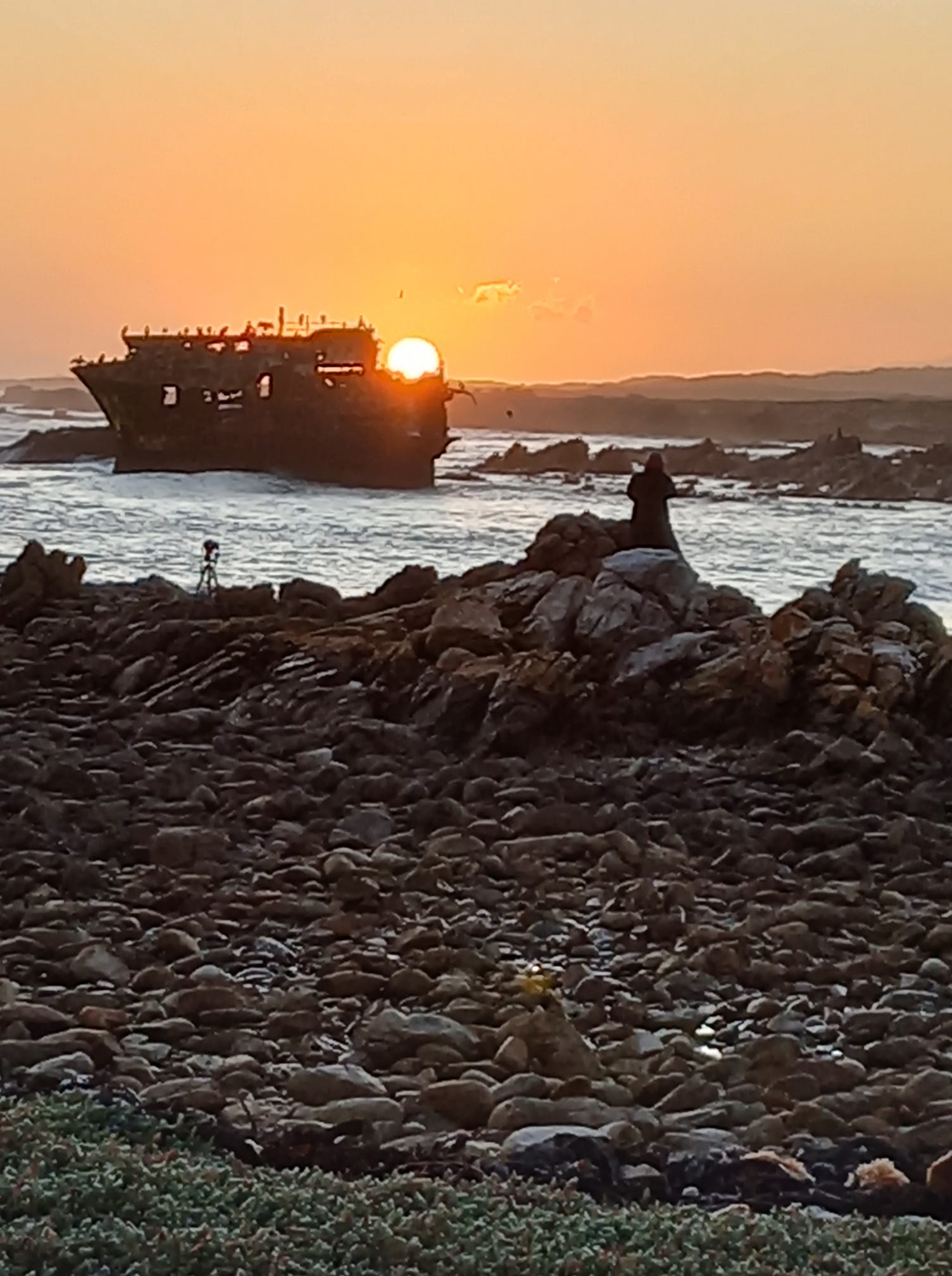
The Meisho Maru No. 38 (1982) taking a battering from the sea in 1984, two years after it had wrecked

1982: Meisho Maru No. 38, this motor-powered fishing trawler wrecked about 1km north-west of the Southern Tip of Africa, at L’Agulhas/Cape Agulhas in the Western Cape.

The bow section is all that remains visible above the water of the Meisho Maru No. 38 (1982) today

It is still visible from the shore today, although it is breaking up rapidly. It has been the subject of many photographers since its wrecking.

Purchase photo/4K video: portfolio1 portfolio2
Aerial photo/video service/inquiries: info@traveltonamibia.com
Telegram: ExploringNamibia

Sunday, 3 April 2022

March 16: This day in South African shipwreck History | История кораблекрушений в Южной Африке

SAHRA Maritime and Underwater Cultural Heritage

See also: Namibian shipwrecks

March 16:

“This day in South African shipwreck History”

1847: Gilbert Henderson, this wooden sailing barque wrecked in a south-easterly gale, opposite the old wooden jetty in Port Elizabeth/Gqeberha in Algoa Bay in the Eastern Cape.
1893: Rising Star, this iron steam-powered launch ran aground on Dassen Island off the west coast in the Western Cape after encountering a strong inset current. It is not certain whether it wrecked or was refloated.
1942: Alcyone, this Dutch steam-powered merchant ship sank after striking two mines laid by the German minelayer Doggerbank, 40km west of Cape Town in the Western Cape. All on board made it safely to the boats.
The Alcyone
1991: Craynip, this sailing yacht wrecked in a south easterly gale east of the Dassen Island lighthouse off the west coast in the Western Cape.
The Onibe
1992: Onibe, this motor-powered 5000 tonnage freighter collided with 23 000 tonnage Fathulkhair and foundered south of Quoin Point in the Western Cape.
Purchase photo/4K video: portfolio1 portfolio2
Aerial photo/video service/inquiries: info@traveltonamibia.com

Saturday, 2 April 2022

March 15: This day in South African shipwreck History | История кораблекрушений в Южной Африке

SAHRA Maritime and Underwater Cultural Heritage

See also: Namibian shipwrecks

March 15:

“This day in South African shipwreck History”

1847: Montgomery, this sailing vessel wrecked in a south easterly gale on a reef off Cape Agulhas in the Western Cape.

1859: Eliza, this vessel wrecked in the Great Brak River in Mossel Bay in the Western Cape.

1972: Breerivier, this motor-powered fishing vessel wrecked at Cape St Martin on the Vredenburg Peninsula off the west coast in the Western Cape.

1990: Rigil K, this sailing yacht wrecked at Bokpunt, just north of Cape Town, off the west coast in the Western Cape after drifting for almost 30km.

Purchase photo/4K video: portfolio1 portfolio2
Aerial photo/video service/inquiries: info@traveltonamibia.com
Telegram: ExploringNamibia

Sunday, 20 March 2022

March 12: This day in South African shipwreck History

SAHRA Maritime and Underwater Cultural Heritage

See also: Namibian shipwrecks

Today, March 12:

“This day in South African shipwreck History”

1826: Perseverance, this wooden sailing vessel wrecked on Whale Rock off Robben Island in Table Bay in the Western Cape.

1908: Newark Castle, this steel steam-powered mail ship struck an unknown obstruction and sprang a leak, just north of Port Dunford, in KwaZulu-Natal. The seas were calm, but the master was afraid that the ship may capsize and made the call to launch the boats and abandon ship to ensure the safety of the 69 crew and 48 passengers.

The next morning, the trawler Elelyn rescued all but one of the boats. The last boat attempted to reach the shore, but was swamped, resulting in a passenger and two members of the crew drowning. With the increasing roughness of the sea, the unmanned Newark Castle floated off and drifted 11 km north, finally striking a sandbank near the modern-day Richards Bay breakwater and becoming a total loss.

A court of inquiry was held, but they found that the loss of the Newark Castle could not be proved to be due to any misconduct or negligence of the master or chief officer. The remains were discovered in the 1970’s during construction work in the Richards Bay harbour, but it was left in situ.

Purchase photo/4K video: portfolio1 portfolio2
Aerial photo/video service/inquiries: info@traveltonamibia.com

Friday, 18 March 2022

March 11: This day in South African shipwreck History

SAHRA Maritime and Underwater Cultural Heritage

See also: Namibian shipwrecks

Today, March 11:

“This day in South African shipwreck History”

1837: Maria, this wooden sailing brig wrecked during a south easterly in Algoa Bay in the Eastern Cape.

1840: Hope, this sail (schooner) and paddle-wheeled steam-powered coaster wrecked near Wreck point, west of Oyster Bay in the Eastern Cape. Whilst in a thick mist it struck a ridge of rocks about 200m from the shore. The captain thought that they were 40km from the shore. Only one of the two lifeboats were usable, so a second one was manufactured and towed to shore using the first. A return journey resulted in all 72 people that were on board being saved. The vessel became a total wreck and is known as the first steamer to have wrecked on the South African coast. 

1842: Adolph Fanny, this French sailing barque was put into Table Bay in the Western Cape for repairs and caulking in but was condemned after inspection. 

1853: Agatha, this sailing cutter capsized and wrecked whilst crossing the bar of the Mthatha river near Coffee Bay in the Eastern Cape.

1894: Seagull, this three-masted wooden sailing schooner wrecked in a south easterly gale after its cables parted just off De Bakke beach in Mossel Bay in the Western Cape.

1943: Aelybryn, this steam-powered ship was the final vessel to be claimed by the infamous U-160. Late at night and unescorted the Aelybryn was struck by two torpedoes fired from U-160. The Germans questioned the survivors and again, a misunderstanding resulted in the incorrect name being reported, this time the Aelybryn was reported as being the Arian. Out of the 41 on board, The Lourenço Marques picked up 32 survivors and landed them in Cape Town, meaning nine lives were lost. This was the Aelybryn’s second time being attacked by a German U-boat, having had an encounter with U-556 two years earlier which it managed to survive with some damage and the loss of life of one crew member. As for the fate of U-160 and its crew, they were sunk by the US Navy on the 14th of July 1943, near the Azores islands in the North-Eastern Atlantic.

1944: Uit-22, this Italian submarine, which was taken over by the Germans after the Italians surrendered, was sunk by Wing Commander ESS "Gar" Nash in an RAF Catalina south of Cape Point in the Western Cape. All 46 on board were killed.

1968: Dirkie Uys, this motor-powered vessel wrecked at Cape Infanta in the Western Cape.

1971: Gansie Een, this motor-powered fishing vessel wrecked opposite Die Baken near Cape Agulhas in the Western Cape. One life was lost because of the wrecking.

Purchase photo/4K video: portfolio1 portfolio2
Aerial photo/video service/inquiries: info@traveltonamibia.com

Tuesday, 3 March 2020

South Africa: newly found shipwreck at Bloubergstrand Beach, Cape Town

Newly found shipwreck at Bloubergstrand Beach, Cape Town, South Africa

Photos: Dronesberg


Special thanks: Clare Lindeque


Shipwrecks in Namibia: link

We were in Cape Town in January 2018. While walking around Bloubergstrand beach on 30.01.18 we saw a group of workers digging out some wooden pieces of shipwreck (?). Do you know what this ship was? I found your blog when searching for information about Athens wreck at Green Point.
Hi,

I am not familiar with that wreck - it looks as though it was buried very deep in the sand! The people doing the work were probably from SAHRA, The South African Heritage Resources Agency. There are many, many forgotten wrecks under the sand and in the shallows along that stretch of coastline, and it is great to see one of them getting some attention!

Hi,

I messaged SAHRA about the wreck you saw, along with one of your photos, and this is what they said:

There is currently a project being undertaken along the beach at Blouberg to locate the wreck of the Haarlem which wrecked somewhere along the bay in 1647. A geophysical survey was undertaken to try and pinpoint places to look more closely at and then small test excavations were undertaken to uncover what was picked up in the survey. A few pieces of wreckage were uncovered but as yet they have not been identified. The African Institute for Marine and Underwater Research (AIMURE) is the organisation that has been undertaking the project and have been doing it under permit from SAHRA. They will publish the results of the survey in the near future.

This is really cool - the Haarlem was a Dutch ship that wrecked at the Cape in 1647. The survivors of the wreck spent a little bit of time here before being rescued, and I think when they got back to Holland they reported that the Cape had water and fertile soil etc etc - and that it would be a good place for a settlement/refreshment station. Following that, Jan van Riebeeck was sent here and the rest is history. So it is a very significant wreck in the history of European settlement at the Cape, and finding it would be extremely exciting!
The shipwreck that changed South Africa forever

The "Haarlem" ("Nieuw Haarlem"), Dutch East India Company's (VOC) ship (one of numerous "Indiamen"), sank at the coast of Table Bay on Sunday, 25 March 1647 during the storm. "Haarlem" was constructed at the VOC Amsterdam shipyard with a length of about 45 metres and a width of 10 metres.
The route around the Cape was particularly treacherous and was officially known as the Cape of Good Hope or Cabo do Bona Esperana (Portuguese). It was soon renamed the Cape of Storms as many "Indiamen" ran aground or sank while negotiating the route around the Cape Peninsula.

58 crew members were repatriated by accompanying ships soon after the incident with 62 men left behind to salvage as much of the cargo as possible - spices, pepper, porcelain and textiles. They built in a makeshift camp, Fort "Zandenburch" (Dutch for Sandcastle), where they lived for about one year, bartering livestock and fresh meat from the indigenous Khoe Khoen people. They had a great success fishing in the nearby Salt River and ventured as far as Robben Island.
Crew men reported favourably on their experiences when they returned to Holland and, as a result, VOC management decided to establish a stopover for their ships. This restocking settlement, known as the "Tavern of the Seas", where ships stopped for replenishing of water and food supplies, later developed into the city of Cape Town. The wrecking of Haarlem can be regarded as the starting point that created the roots of the modern South African society.

The site is situated just off shore at a depth of about 3 to 4 m below the sea bed, close to the Dolphin Beach Hotel in Table View, Sunset Beach and parking area at Rietvlei, Cape Town. No shipping accident around the world had ever such an impact on the history of a whole nation, according to AIMURE. Table Bay is location of more than 350 recorded shipwrecks.
Purchase photo/4K video: portfolio1 portfolio2
Aerial photo/video service/inquiries: info@traveltonamibia.com