Showing posts with label Knysna. Show all posts

Thursday, 19 December 2024

South Africa: Thomas, Uitenhage Packet, Winifred & Maria, Urania, Crusader, Mary Emily, Pisang & Fair Helga shipwrecks

SAHRA Maritime and Underwater Cultural Heritage

James Searle wreck, South Africa

August 29:

“This day in our shipwreck and aeronautical wreck history”

1819: A south-easterly gale claimed three vessels on this day, all belonging to Frederick Korsten, and all being driven ashore at the Baakens River mouth in Port Elizabeth in the Eastern Cape. The Good Hope managed to survive another day before being claimed on the 30th.

• Thomas, a wooden-hulled coaster.

• Uitenhage Packet, a wooden-hulled schooner. This was the only ship known of to have ever sailed up the Swartkops River.

• Winifred & Maria, a wooden-hulled brig.

1851: Urania, this wooden-hulled barque ran aground on the lee bank in the Durban Harbour in KwaZulu-Natal and although it was eventually gotten off, it was condemned.

1868: Crusader, this sailing brig wrecked in a south-easterly gale near Esplanade Rocks in East London in the Eastern Cape.

1880: Star of Africa, this iron-hulled sailing barque wrecked on Albatross Rock near Olifantsbos in the Western Cape. The Australian Register recounts the story of one of two survivors of the 16 that were on board. At about 04:30 am, the barque struck Albatross Rock and sails were at once set to head for the shore. It struck again and started going down instantly. There was no time to launch any boats and the second mate managed to cling to a hencoop whilst the sinking ship caused a vortex, pulling most things and people down. After the vortex settled, he found an upturned boat with four or five others trying to right it. By the time it was righted, only three people made it on. With a single oar in a waterlogged boat, they managed to reach the shore, with only the second mate and a seaman surviving and the other man having died from exhaustion in the boat.

1889: Mary Emily, this wooden-hulled barque foundered during an easterly gale in heavy seas at night in Durban in KwaZulu-Natal. During the night, the tug Churchill, had left the harbour to render assistance and to attempt to bring it over the bar in the heavy seas. They struggled to achieve this, so the attempt was abandoned, and it was then assumed that the barque had weighed anchor and made it out to sea. It appears that instead, whilst in the outer anchorage in the heavy seas, its anchor chain tore open its bow and its cargo of coal made it sink like a rock. The loss was only noticed the following morning when the beach became littered with debris. Over the following weeks, 9 bodies washed ashore with two bodies having never been found. Three weeks later, the tug Forerunner was sent to investigate wreckage at about 11m in depth, opposite the Rocket House and they found the wreck site.

1914: Pisang/Piesang, this Norwegian iron-hulled whaler foundered on the Knysna Bar in Knysna in the Western Cape after having struck Emu Rock. Five of the crew of 11 were lost. There is some speculation amongst the diving community that the “Phantom Wreck”, at about 2-8m in depth, might be this vessel, but more research is required to determine this accurately.

1927: Fair Helga, this steel-hulled steam-powered whaler foundered after springing a leak east of Durban in KwaZulu-Natal. The leak was noticed at around 08:15 and by 10:15 all efforts to plug it had failed and so it was abandoned by 11:00 shortly after which it foundered. The crew was picked up the Sandgate Castle.

Purchase photo/4K video: portfolio1 portfolio2
Aerial photo/video service/inquiries: info@traveltonamibia.com
Telegram: ExploringNamibia

Wednesday, 4 December 2024

South Africa: Winnifred & Maria, Isabel, Trekboer, Spy, Pisa, Texanita & Kiani Satu shipwrecks

SAHRA Maritime and Underwater Cultural Heritage

August 21:

“This day in our shipwreck and aeronautical wreck history”

1817: Winnifred & Maria, this wooden-hulled brig wrecked near the Table Bay Wharf in Table Bay in the Western Cape. It now lies beneath reclaimed land.

1844: Isabel, this wooden-hulled barque was captured by the HMS Cleopatra and was en-route to Simon’s Bay in the Western Cape for adjudication when it lost its rigging and was brought into Algoa Bay in the Eastern Cape, where it was driven ashore and condemned. It was due for adjudication as it was found with cargo stores for engaging in the slave trade. On this day, while anchored in Algoa Bay, its cables parted during a south easterly gale, and it was wrecked. It was officially condemned on the 2nd of October.

1844: Trekboer, this wooden-hulled schooner wrecked in the same south easterly gale as the Isabel in Algoa Bay in the Eastern Cape. A boy was lost his life during the wrecking.

1851: Spy, this wooden-hulled brigantine wrecked after its cables parted in a south easterly gale in St. Francis Bay in the Eastern Cape.

1879: Pisa, this Italian wooden-hulled barque struck a reef 32 km from Cape Agulhas in the Western Cape on the 20th and started leaking. The captain tried to reach False Bay, but by the night of the 21st he decided to drive it ashore as he feared it would founder. He attempted to beach the barque near the mouth of the Bot River in the Western Cape but struck a rock before reaching the shore and wrecked. One newspaper article claims that the entire wreck washed ashore, whereas a different one claims that after its cargo was removed and it was stripped, its hulk remained on the rocks and eventually disappeared below water.

1972: Texanita, this Panamanian supertanker collided with the tanker Oswego Guardian in thick fog, off Stilbaai in the Western Cape and foundered. The oil vapours in the Texanita caused a massive explosion which broke the ship in two and it sank within 4 minutes. The event resulted in the loss of 47 lives on board the Texanita and the loss of one life from the Oswego Guardian. Three men from the Texanita and one from the Oswego Guardian were taken to a hospital in Mossel Bay. The oil spill at the time slicked approximately 500 penguins. The Oswego Guardian underwent repairs in Table Bay and continued tanking. At the time, this was the biggest collision in terms of size of vessels involved. The explosion on board the Texanita was heard over 100 km away and resulted in international regulations for the transport of inert gasses to be amended for safety.

2005: A privately operated Britten-Norman BN-2 Islander (registration no. ZS-PCJ) encountered engine problems shortly before attempting to land at Virginia Airport in Durban in KwaZulu-Natal. During the landing attempt, the airplane drifted from the centre line and a go-around was attempted. This was unsuccessful with the airplane continuing banking to the left and the pilot flew over the M4 highway and struck a house’s roof with the nose and left wing, coming to rest with the tail high in the air. The 5 occupants and pilot survived albeit with many injuries, but the airplane was damaged beyond repair.

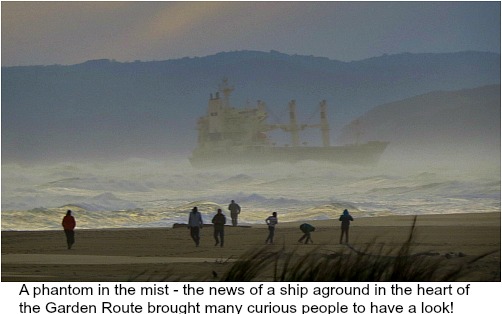
2013: Kiani Satu, this bulk carrier was towed out to sea about 200 km from Knysna in the Western Cape and scuttled by the South Africa Maritime Safety Authority (SAMSA). After encountering engine failure, the 165 m bulk carrier was driven close to the coast and it came to rest just off the Goukamma River Mouth, near Buffels Bay, in the Western Cape where its crew was airlifted to safety.

Rescue operation by NSRI

Various governmental departments worked together to attempt to protect coastal resources from an oil spill and to remove the vessel’s fuel and cargo to lighten it enough to be towed to deeper waters. This was eventually achieved, with the bulk carrier being towed out to sea and finding its final resting place over 1000 m deep, 200 km from the coast. The following weeks involved much cleanup with the result being the oiling of over 150 sea birds, and the death of 14 sea birds and two seals.

Purchase photo/4K video: portfolio1 portfolio2
Aerial photo/video service/inquiries: info@traveltonamibia.com
Telegram: ExploringNamibia

Friday, 22 November 2024

South Africa: rubber bales along the beaches

SAHRA Maritime and Underwater Cultural Heritage

August 15:

If you have walked along Blouberg Beach over the last few days  heading towards Eerstesteen you may have come across a strange object lying in the surf. It is a rubber bale, one of many to have been washed up along our coast over the last few years though this is the first to be reported in Cape Town. Most of the other reported bales have been found along the South Coast, Mossel Bay, Knysna, Port Elizabeth, Sedgefield and the Cape St Francis area, though a few have been washed up along the West Coast near Paternoster.

They are thought to come from the British freighter 'Helmspey', which was torpedoed 11 miles south of Cape St Francis by a German submarine (U-516) on 11 February 1943. The ship was allegedly transporting around 1 457 tons of these rubber bales from Ceylon to the UK. There is also a chance that some of these bales come from the British merchant ship 'Boringia' which was carrying a cargo of rubber bales from South East Asia when she  was torpedoed and sunk by U-boat (U-159) on 7th October 1942 far off the Western Cape.

Purchase photo/4K video: portfolio1 portfolio2
Aerial photo/video service/inquiries: info@traveltonamibia.com
Telegram: ExploringNamibia

Friday, 27 September 2024

South Africa: Mary, Silistria, Guerdon, Jupiter & Francis Repetto shipwrecks

SAHRA Maritime and Underwater Cultural Heritage

Benguela Eagle shipwreck in Namibia

July 9:

“This day in our shipwreck and aeronautical wreck history”

1824: Mary, this wooden-hulled sailing vessel wrecked near De Bakke beach in Mossel Bay in the Western Cape after it came into the bay for water.

1862: Silistria, this sailing barque was supposedly last seen burning off Knysna in the Western Cape on this day. The crew was taken off by the Ramillies and landed at St Helena. There are however two other reports, one of which claims that the burning vessel was actually the Rose and another that claims the Silistria wrecked in September of this year instead. More research is needed to confirm this and to clear up the confusion.

1929: Guerdon, this steel steam-powered ship was abandoned due to engine trouble near the Msikaba River mouth in the Eastern Cape where it wrecked. Its boiler is supposedly visible on Sikombe Beach.

1930: Jupiter, this iron steam-powered ship was written off in 1925 and sold as a wreck. On this day, five years later it was finally condemned in Durban in KwaZulu-Natal.

1971: Francis Repetto, this motor-powered fishing trawler sunk whilst under tow about 15 km from Robben Island in the Western Cape.

Purchase photo/4K video: portfolio1 portfolio2
Aerial photo/video service/inquiries: info@traveltonamibia.com
Telegram: ExploringNamibia

Saturday, 14 September 2024

South Africa: Luna, Scotland, Mincio, Weol-Mi No. 303 & BOS 400 shipwrecks

SAHRA Maritime and Underwater Cultural Heritage

June 27:

“This day in our shipwreck and aeronautical wreck history”

1830: Luna, this wooden British brig wrecked just outside of the Knysna Heads in the Western Cape. It left Knysna on this day and despite a smooth bar and fair wind, it had ran aground on the sandbank outside the bar and within two days, drifted into the surf. The crew had abandoned it by this point and it wrecked.

1860: Scotland, this British sailing ship was lost at Montgomery Point at Cape Agulhas in the Western Cape.

1908: Mincio, this Dutch tug either ran aground and was refloated or wrecked at Port Nolloth in the Northern Cape.

1968: Weol-Mi No. 303, this South Korean fishing vessel wrecked on rocks near the Mkambati River mouth in the Eastern Cape.

What remained of the Weol-Mi No. 303 (1968) in 2016

1994: BOS 400, this French crane barge ran aground on the rocks in Maori Bay near Hout Bay in the Western Cape. The barge was being towed to Cape Town by the Russian tug Tigr when its cables parted during heavy seas, and it drifted onto the rocks. The crew of 18 were rescued by helicopter. Numerous attempts were made to tow it off the rocks, but it could not be saved and was declared a total loss.

The NSRI at the wreck of the BOS 400 in Maori Bay, in early 2021, responding to an emergency in which a teenager became injured after jumping off the wreck

It lies partially on top of the wreck of the Oakburn (1906) and as the BOS 400 breaks apart, the wrecks of the two vessels are becoming mixed. The BOS 400 is a popular tourist attraction with many people enjoying the hike along the coast to view it. There are lots of instances of people climbing onto the wreck to explore the inside and to jump from the wreck into the sea below. However, as the BOS 400 continues to deteriorate the site is becoming much more dangerous, so it is advisable to admire the wreck from a distance instead.

Purchase photo/4K video: portfolio1 portfolio2
Aerial photo/video service/inquiries: info@traveltonamibia.com
Telegram: ExploringNamibia

Wednesday, 14 August 2024

South Africa: Schuylenburg, Surrey, Annie, Hansa, Catarina Doge, Trevelyan, Skarpjhedinn, Seatrader & Hung Mou Hao shipwrecks

SAHRA Maritime and Underwater Cultural Heritage

June 3:

“This day in our shipwreck and aeronautical wreck history”

1756: Schuylenburg, this wooden Dutch sailing packet ran into a violent storm and disappeared somewhere near Camps Bay in the Western Cape. The wreck site of the National Heritage Site, the São José (1794) was originally misidentified as being that of the Schuylenberg by divers before it was properly researched.

1857: Surrey, this wooden barque foundered off Cape Recife in the Eastern Cape.

1857 or 1859: Annie, this wooden brigantine was lost off the Cape Peninsula in the Western Cape.

1883: Hansa, this German brig wrecked at night during a north-westerly gale near Danger Bay in the Western Cape. Its wrecking resulted in the death of seven of the nine people that were on board.

1886: Catarina Doge, this wooden Italian barque ran aground and broke up just north of Olifantsbos Point on the Cape Peninsula in the Western Cape. Five lives were lost during the wrecking.

1888: Trevelyan, this British emigrant sailing vessel was last sighted on this day by the Drummond Castle in a gale off Cape Agulhas in the Western Cape. It is assumed that it foundered that night with the loss of all hands. In October of 1888, one of its lifebuoys washed up at Knysna in the Western Cape.

The Trevelyan (1888) docked, presumably at Sunderland Bay, Australia

1936: Skarpjhedinn, this steel South African steam-powered whaler was scuttled at 14:59 off Durban in KwaZulu-Natal.

1971: Seatrader, this motor-powered Liberian cargo freighter ran aground at full speed in thick fog on Cape St. Martin on the Vredenburg Peninsula in the Western Cape. Its engine block is sometimes visible protruding from the water today.

All that is visible of the Seatrader (1971) today at low tide

1976: Hung Mou Hao, this Taiwanese fishing trawler was lost at sea because of an explosion and a subsequent fire, about 500 km northwest of Cape Town in the Western Cape.

Purchase photo/4K video: portfolio1 portfolio2
Aerial photo/video service/inquiries: info@traveltonamibia.com
Telegram: ExploringNamibia

Sunday, 28 July 2024

South Africa: Papa Risetto, Mabel, Seier & Sceptre shipwrecks

SAHRA Maritime and Underwater Cultural Heritage 

May 23:

“This day in our shipwreck and aeronautical wreck history”

1888: Papa Risetto, this Italian sailing barque foundered in a hurricane near Morgan's Bay in the Eastern Cape. The crew was rescued by the Myvanwy and taken to Durban.

1909: Mabel, this wooden British cutter capsized outside of Salamander Bay in Saldanha Bay in the Western Cape. Three people drowned during the wrecking.

1910: Seier, this wooden Norwegian sailing barque struck a rock west of Walker Point near Knysna and was beached two hours later in Buffalo Bay in the Western Cape. It was carrying creosote as cargo when it wrecked which harmed the marine live all the way from Sedgefield to Knysna.

1925: Sceptre, this steam-powered British cargo ship struck a submerged object at 21:10 the night of the 22nd near Struisbaai in the Western Cape.

A porcelain washbasin which was salvaged from the Sceptre (1925) and is on display at the Bredasdorp Shipwreck Museum

At 09:30 on the 23rd the captain abandoned ship with his crew, and they were picked up by the SS Mineric and were landed at Algoa Bay in the Eastern Cape. As for the fate of the Sceptre, it came lose and ran aground, wrecking about 900 m off Northumberland Point and by the 27th had broken its back.

Purchase photo/4K video: portfolio1 portfolio2
Aerial photo/video service/inquiries: info@traveltonamibia.com
Telegram: ExploringNamibia

Saturday, 1 June 2024

South Africa: Phoenix, Ellida, Dundrennan, Frontier II, Sydostlandet, Sri Rezeki & Mombak 572 shipwrecks

SAHRA Maritime and Underwater Cultural Heritage

April 6:

“This day in our shipwreck and aeronautical wreck history”

1881: Phoenix, this 3-masted sailing schooner washed up at the Noetsie River Mouth near Knysna in the Western Cape. Reports vary, but the most likely story is that it was abandoned at sea, with no trace of its master or crew ever being found.

1888: Ellida, this sailing barque wrecked in a north-westerly gale at Danger Point near Gansbaai in the Western Cape.

1895: Dundrennan, this British iron fully rigged sailing vessel wrecked in fog on Saxon/Bulldog reef at Struispunt, near Arniston/Waenhuiskrans in the Western Cape. The wrecking resulted in the loss of 25 lives.

1938: Frontier II, this steel motor-powered coaster wrecked in a severe storm on the rocks north of the Shixini River in the Eastern Cape.

The Frontier II (1938), date and location unknown

Some reports suggest that it was driven ashore due to dense fog and a strong inset. The scattered wreckage and remains are still visible on the rocks.

1942: Sydostlandet, this motor-powered seaward patrol vessel ran aground and wrecked in the Umgeni River Mouth at Umhlanga Rocks in KwaZulu-Natal. It was declared a constructive loss - the only South African naval loss incurred during WWII that was not the result of enemy action.

1971: Sri Rezeki, this Indonesian motor-powered cargo vessel/coaster struck an unidentified object which stopped its engines, and it began taking on water.

The Sri Rezeki (1971) being battered to pieces by the waves at Jongesfontein

With the pumps not coping and to avoid capsizing, the master steered it towards land, and it grounded on a rocky shelf at Jongensfontein, near Stilbaai/Still Bay in the Western Cape. The big seas quickly reduced it to a wreck.

1992: Mombak 572, this motor-powered ski boat foundered in a south-easterly gale near the Gordon’s Bay harbour in False Bay in the Western Cape, with one person drowning in the event.

Purchase photo/4K video: portfolio1 portfolio2
Aerial photo/video service/inquiries: info@traveltonamibia.com
Telegram: ExploringNamibia

Monday, 20 May 2024

South Africa: Nautilus, Columbine, Emma, Lord Elgin & Knysna shipwrecks

SAHRA Maritime and Underwater Cultural Heritage

March 31:

“This day in our shipwreck and aeronautical wreck history”

1826: Nautilus, this wooden sailing brig wrecked in Table Bay in the Western Cape.

1829: Columbine, this wooden sailing vessel wrecked north of the Cape Columbine Lighthouse off the west coast in the Western Cape. The lighthouse, which was built in 1936, is named after this wreck.

Cape Columbine Lighthouse: the Cape Columbine Lighthouse’s namesake is the nearby wreck of the Columbine (1829). Interestingly, another vessel, the Columbine (1944), a steam-powered merchant ship, was torpedoed about 40 km from this lighthouse on the 16th of June by U-198.

1888: Emma, this wooden sailing vessel wrecked in the Mpekweni River, north of the Fish River lighthouse in the Eastern Cape.

1904: Lord Elgin, this British steel barque struck a rock and foundered in Algoa Bay in the Eastern Cape.

1952: Knysna, this motor-powered fishing vessel was scuttled at Cape Recife in Algoa Bay in the Eastern Cape.

Purchase photo/4K video: portfolio1 portfolio2
Aerial photo/video service/inquiries: info@traveltonamibia.com
Telegram: ExploringNamibia

Tuesday, 2 April 2024

South Africa: Isaac, Volo & H C Hull shipwrecks

SAHRA Maritime and Underwater Cultural Heritage

March 6:

“This day in our shipwreck and aeronautical wreck history”

1847: Isaac, this sailing sloop wrecked west of Struisbaai in the Western Cape.

1896: Volo, this Norwegian wooden sailing barque wrecked in thick fog, and due to a faulty chronometer, between the Bushman’s and Kariega River mouth at Kenton-on-Sea in the Eastern Cape.

The Volo (1896) after having run aground

The wreck often washes open, and the remains of its hull can be seen sticking out of the sand. Timber used by locals to build sheds at Bushmans River.

The Volo (1896) can often be seen sticking out of the sand after a storm or a spring low tide

1961: H C Hull, this motor-powered pilot tug was scuttled in Algoa Bay in the Eastern Cape.

1962: Mount Prospect, an SAA Douglas C47B (registration no. ZS-DJC), which is a domestic passenger transport plane, crashed about 11 km North of Seymour into the Katberg Mountain area in the Eastern Cape whilst flying below a heavy cloud base. The pilot and co-pilot were killed with three of the crew and two passengers surviving. The ground engineer had to walk down the mountain to get help.

ZS-DJC "Mount Prospect" (1962) date and location unknown

1999: A passenger transport helicopter, a Bell 206B Jet Ranger III (registration no. ZS-REB), crashed in the dense forests in Knysna in the Western Cape with all three that were on board losing their lives. Search and rescue operations scoured the general south coast area for a week, but no sign of the helicopter was found. Seven years later, a forest worker, who was busy preparing trees for an event that only occurs once every ten years stumbled upon the wreckage. The cause of the accident was assumed to be flying below obscure weather conditions and colliding with the terrain accidentally.

Purchase photo/4K video: portfolio1 portfolio2
Aerial photo/video service/inquiries: info@traveltonamibia.com
Telegram: ExploringNamibia

Saturday, 9 March 2024

South Africa: Emu, Nepaul, Helmspey & Blomvlei shipwrecks

SAHRA Maritime and Underwater Cultural Heritage

February 11:

“This day in our shipwreck and aeronautical wreck history”

1817: Emu, this sail-driven transport brig was the first vessel to attempt to enter Knysna Lagoon in the Western Cape, where it promptly wrecked. It was originally built as a merchant brig and was hired and equipped as an armed transport by the Royal Navy. After having been discharged from the Colony of New South Wales service, it was on its way home to be sold in England when it was damaged in a hurricane. It struck a rock in False Bay and foundered but was refloated and repaired in Simon's Town. The authorities decided to use it for running local errands after repairing it. It was dispatched to Plettenberg Bay to fetch a cargo of timber, with instructions that the captain was to chart the Knysna lagoon from a small boat before entering the area with the brig. A favourable wind and flat bar however tempted him to sail the brig into the lagoon, where a sudden contrary wind blew it onto the eponymous Emu rock. The crew managed to beach the brig, but the damage sustained meant that it was to become a wreck. Almost three months later, the HMS Podargus arrived to pick up the Emu’s cargo and crew and entered the lagoon, passing through the Knysna Heads safely.

1850: Nepaul, this British East Indiaman wrecked near the mouth of the Swart River at Sedgefield in the Western Cape. After a long journey returning from the East, the passengers and crew anchored on the southern African coastline to relax and enjoy the fine weather, in front of what is today, Sedgefield.

A depiction of the Nepaul (1850) caught on the rocks and being battered by the heavy seas. Drawing by an unknown artist

Shortly after returning from land, the weather turned, and a storm erupted. The Nepaul was driven onto the nearby rocks where it struck hard and wrecked. For more than three days, the passengers and crew held onto the remains of the ship. The few lifeboats that were launched were smashed to pieces on the rocks. In desperation, one of the crew tied himself to floating debris in an attempt to reach the shore, but he drowned.

A depiction of the two of the female passengers of the Nepaul (1850), Mrs Bell and Mrs Drago as well as Mrs Drago's two children, who were tied to the mast for safety, where they remained for three days until the weather calmed and they could reach the shore with the impromptu rafts. Drawing by an unknown artist

By the fourth day, the wind started to calm and with impromptu rafts made from the wreckage, a final attempt was made by all to reach the shore. Two more of the crew were washed from their rafts and drowned. From the 25 that were on board, in total three of the crew were lost with all the passengers being kept alive. The Meeding family, who owned the nearby farm Rugtevlei (that would eventually become Sedgefield), housed the survivors and took care of them before they left for Knysna to find passage on other vessels back to England. It is reported that one of the crew stayed on to work for the Meeding family.

A depiction of one of the impromptu rafts of the Nepaul (1850) being pulled to shore. Drawing by an unknown artist

The remains and cargo of the Nepaul were later sold with much of the furniture finding its way into local families and being passed down the generations. Its rudder and portholes were incorporated into the ‘Annie Benn’, a schooner built in Knysna. The ‘Anchor Café’ of Sedgefield (today the Forest Lodge) reportedly received its name from the anchor of the Nepaul which was moved there some years after the wrecking. The whereabouts of the anchor today are unknown.

1943: Helmspey, this British steam-powered merchant vessel was torpedoed and sunk south of Cape St Francis in the Eastern Cape.

The Helmspey (1943) in Vancouver, Canada, date unknown

U-516 struck it with a torpedo at 06:52 and fired a coup de grâce at 07:12. Of the 46 that were on board, four perished and the rest were picked up by a SAAF crash launch and landed at Algoa Bay. One more member of the crew perished from his injuries in hospital.

1966: Blomvlei, this motor-powered fishing vessel was scuttled off Robben Island in Table Bay in the Western Cape.

Purchase photo/4K video: portfolio1 portfolio2
Aerial photo/video service/inquiries: info@traveltonamibia.com
Telegram: ExploringNamibia

Thursday, 8 November 2018

South Africa: Brenton Haven Beachfront Resort - news from African Anthology

#SouthAfrica #Knysna #ButterflyBlueNatureReserve #BrentonHavenBeachfrontResort #GardenRoute #WesternCape #AfricanAnthology

Introducing Brenton Haven Beachfront Resort

Accommodation in South Africa

We are very excited to announce the inclusion of Brenton Haven Beachfront Resort in our portfolio.

Its been a dream to have a beach front property within our portfolio, enabling us to showcase even more of our beautiful continent to our travel partners, and complementing our existing spectacular portfolio.

Brenton Haven is a family owned and run luxury 4 star resort situated in Brenton On Sea, Knysna and offers the perfect start or end for the Garden Route. The property offers 26 beach villas and 9 luxury suites which can be booked on a self-catering or bed and breakfast basis. The Butterfly Blu restaurant on site offers all day dining, and the on-site deli allows for guests to purchase items to be enjoyed from the comfort of their apartment.

Each room, as well as the restaurant offer spectacular vistas of the Indian ocean, set against a back drop of the Butterfly Blue Nature Reserve.  Guests can walk down to the bathing beach, or explore the exquisite surrounds of the hotel at their leisure, if time allows in-between exploring all that Knysna has to offer.
Purchase photo/4K video: portfolio1 portfolio2
Aerial photo/video service/inquiries: info@traveltonamibia.com