Showing posts with label Martha. Show all posts

Wednesday, 15 January 2025

South Africa: Le Victor, Martha, Suffolk & Flatdog shipwrecks

SAHRA Maritime and Underwater Cultural Heritage

Unknown wreck in Walvis Bay, Namibia

September 24:

“This day in our shipwreck and aeronautical wreck history”

1782: Le Victor, this wooden sailing corvette wrecked in a north-westerly gale at the Salt River mouth in Table Bay in the Western Cape. Records indicate that ‘nearly’ all aboard were saved, but the exact number of casualties is unknown. The wreck now lies beneath reclaimed land.

1826: Martha, this wooden sailing brig wrecked on the eponymous Martha Reef at Martha Point northeast of Arniston/Waenhuiskrans in the Western Cape.

1900: Suffolk, this four-masted steel steam-powered ship wrecked west of Cape St Francis near Tsitsikamma Point in the Eastern Cape after striking a reef and its holds flooding. A smaller steamer, the Lake Erie, was passing nearby and rescued all that were on board. However, the 900 horses that were being transported were left on board the ship, which disappeared below the waves later in the day. Wreckage washed up as far west as the Great Brak River and later investigations by the authorities found that many of the farm houses had used timber from the wreck that had washed up as there was a Troop letter stamped into the timber used for the horse stalls which made identification quite easy.

1996: Flatdog, this South African yacht collided with a fishing vessel in Algoa Bay in the Eastern Cape and whilst being towed back for repairs, it foundered.

2009: A SA Airlink British Aerospace Jetstream 41 (registration no. ZS-NRM) suffered an engine failure shortly after taking from Durban International Airport in KwaZulu-Natal and crash landed about 1.6 km from its takeoff runway in the Merebank residential area, skidding through an electrical pole, over a road, and eventually coming to rest against a concrete palisade. The two pilots and one flight attendant on board were seriously injured, with the one pilot succumbing to his injuries on the 7th of October. The wing of the airplane also clipped a member of the public who was seriously injured.

Purchase photo/4K video: portfolio1 portfolio2
Aerial photo/video service/inquiries: info@traveltonamibia.com
Telegram: ExploringNamibia

Friday, 20 December 2024

South Africa: Good Hope, Martha, Ambleside, Teuton, Andreas Riis, Burgomeester, C Boschetto, Drei Emmas, Lada, Rosebud & Ticino shipwrecks

SAHRA Maritime and Underwater Cultural Heritage

August 30:

“This day in our shipwreck and aeronautical wreck history”

1819: Good Hope, this wooden-hulled brig wrecked at the Baakens River mouth in Port Elizabeth in the Eastern Cape in the same south-easterly gale that claimed the Thomas, Uitenhage Packet, and the Winifred & Maria the previous day.

1845: Martha, this wooden-hulled brig wrecked during a south-easterly gale in Mossel Bay in the Western Cape. It entered Mossel Bay because it had lost its boats and was running low on provisions. Its cargo of mail was saved.

1868: Ambleside, this wooden-hulled barque wrecked in a south easterly gale just north of the Mzimkhulu River mouth in Port Shepstone in KwaZulu-Natal. Her cargo of cotton and linseed littered the beach and was sold at auction for a considerable profit.

1881: Teuton, this iron-hulled steam-powered ship struck a chartered rock near Quoin Point in the Western Cape and foundered shortly afterwards near Danger Point in the Western Cape. It was en-route from Table Bay to Algoa Bay when it found itself about 1.6 km off course with the Cape Agulhas lighthouse in sight at 19:00, striking a chartered rock off Quoin Point. The captain inspected the damage and felt confident it would make the journey back to Simons Town for repairs. The crew and passengers manned the pumps and started throwing cargo overboard to lighten it. As a precaution, the lifeboats were also readied.
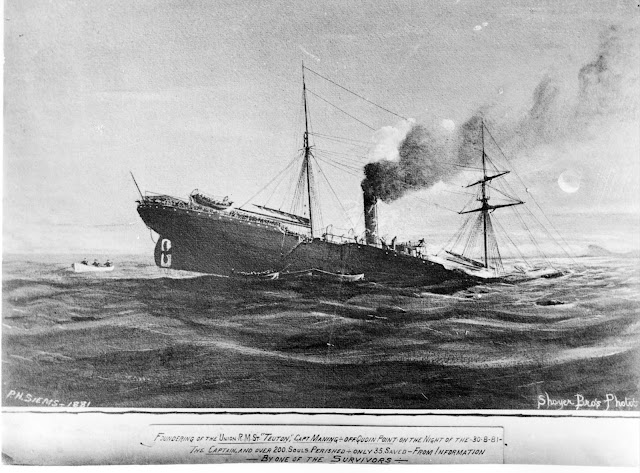
At about 22:00, off Danger Point, the pumps could no longer cope with the incoming water and its stern section raised with the propellor no longer in the water. The first boat was launched in an orderly fashion and filled with children and women and whilst the second boat and third boats were being launched, the Teuton suddenly flipped over, bow first, and sank within minutes. The first boat swamped as a result with only 27 people managing to reach the second and third boats. The two lifeboats made it into Simon's Town and a day later a third lifeboat with only nine souls on board arrived in Table Bay, having struggled to get into False Bay.

It was said at the time that a Miss Rose/Ross provided the clearest account of what had occurred from the perspective of the passengers. She was a teenager and the only woman to have survived the event and in the 2021 wrecking anniversary post, a user commented that she was her great grandmother and was adopted by a rescuer with her name changing to Elizabeth Maxwell. The other 236 souls that were on board the Teuton were lost and the event has gone down as one of the worst maritime disasters from a single ship sinking in South African waters.

1888: A south easterly gale blew into in Port Elizabeth in the Eastern Cape and created havoc in Algoa Bay. Between 8-10 vessels were wrecked or grounded (historical sources vary) but out of all of them only one life was lost during the wrecking and a second, shortly thereafter, possibly linked to a wrecking. 

• Andreas Riis, this Norwegian barque wrecked whilst discharging its cargo of coal.

• Burgomeester (possibly Burgomeester Schorer), this schooner ran aground after discharging its cargo. It was possibly refloated.

• C Boschetto, this Italian barque was put in for repairs and was lost after its cables parted. A local photographer, Mr William Alcock, was called to assist the rocket brigade during its rescue as his ‘limelight apparatus’ was needed to illuminate the scene.

• Dorothea, this German brig was lost shortly after having discharged its general cargo and 4,000 cases of dynamite.

• Drei Emmas, this Belgian barque was lost whilst discharging its cargo of coal.

• Elizabeth Stevens, this British barque was lost and was carrying a cargo of wheat.

• Jane Harvey, this British Barque was lost whilst loading its cargo of mohair.

• Lada, this Austrian barque wrecked after discharging a cargo of rails, and although no lives were lost during the wrecking, the captain died from heart failure shortly thereafter and there is speculation that the loss of the Lada resulted in this.

• Natal, this Swedish schooner wrecked after its cables parted and its cargo had been discharged. 

• Wolseley, this British iron barque wrecked when its cables parted whilst discharging its cargo. One crew member perished.

1888: Rosebud, this wooden-hulled schooner wrecked during a south-easterly gale on Pansy Beach in Mossel Bay in the Western Cape. After its wrecking, the beach was renamed Rosebud Beach, but is sometimes still called Pansy Beach. During spring low tides, some of the wreck protrudes out of the sand.

1908: Ticino, this iron-hulled collier wrecked 8 km south of Port Nolloth in the Northern Cape in heavy seas after the bar in Port Nolloth became impassable and it lost two of its anchors. It broke up within an hour after wrecking.

Purchase photo/4K video: portfolio1 portfolio2
Aerial photo/video service/inquiries: info@traveltonamibia.com
Telegram: ExploringNamibia

Friday, 2 August 2024

South Africa: Lord Hawkesbury, Adventurer, Grahamstown, Elaine, Emma, Jane Davie, Martha, Quanza, Carlos de Eizaguirre & Nagos shipwrecks

SAHRA Maritime and Underwater Cultural Heritage

May 26:

“This day in our shipwreck and aeronautical wreck history”

1796: Lord Hawkesbury, this wooden British whaler was run aground to become a wreck at Soetendalsvlei, presumably near the mouth of Heuningsnes river in Struisbaai/Struis Bay in the Western Cape. It was taken off the coast of Brazil as a prize ship by the French. Amongst the fourteen French men that they put on board, they left three English sailors to sail the vessel to Mauritius, but one of these sailors managed to run it aground when the French officer was not paying attention.

1843: Adventurer, this wooden British cutter foundered in Sandown Bay near Kleinmond in the Western Cape.

1864: Grahamstown, this wooden British barque wrecked in Table Bay on Woodstock beach in the Western Cape. A fire broke out in the hold on the 19th of May and with the holds closed, the crew managed to make it to Table Bay, where it eventually burned down to the waterline. Another source suggests that it instead slipped its cables and wrecked.

1872: A south-easterly gale led to the wrecking of eight vessels in East London in the Eastern Cape and a total loss of three lives. It is recorded that evert single ship that was anchored in East London had been driven ashore, but some were fortunate enough to be refloated.

• Elaine, a British iron brig was smashed to pieces on the breakwater.

• Emma, an American wooden brig became a wreck on the beach.

• Jane Davie, a British iron schooner was driven onto a reef near Bonza Bay. The stricken vessel was only spotted the next morning, and it was only on the 29th that a coasting steamship, the Bismarck arrived and could render assistance as the gale was still raging. Eighteen men and the captain’s wife and son were rescued after spending 3 days lashed to the rigging. Five sailors attempted to use cork buoys to reach the shore, and one of them drowned.

• Martha, a sailing brig that became a wreck on the beach.

• Quanza, a British four-masted steam-powered ship struck the rocks just east of Orient beach and wrecked. Much of the area, such as streets and bathing pools, were named after the wreck.  

• Queen of May, a British wooden barque was smashed to pieces on the rocks. A young boy lost his life. 

• Refuge, a British wooden barque that became a wreck on the beach.

• Sharp, a British wooden brig was driven onto the rocks. One man was killed by a falling block.

1917: Carlos de Eizaguirre, this Spanish steel steam-powered mail ship foundered off Robben Island in the Western Cape. During rough seas at just after 3 am, an explosion occurred, and everyone began to abandon ship. It sunk within five minutes.

The Carlos de Eizaguirre (1917), date and location unknown

Of the 107 crew and 50 passengers on board, only one lifeboat with 23 people on board was launched. The lifeboat was picked up by a tug near Robben Island, and the only other survivor, the chief engineer had managed to find a piece of floating wood after two hours of swimming. He was finally picked up a day and a half later by the coaster Langebaan. As it was never insured for war-time losses, secrecy meant that it was never reported that an explosion occurred but rather that the loss was due to heavy seas. However, it is believed today that it had struck a mine laid by the German commerce raider SMS Wolf. 

1918: Eros, this two-masted British steam-powered ship foundered somewhere near Lambert’s Bay in the Western Cape. All 14 of its crew were lost. 

1971: The Devil’s Peak Tragedy: Three SAAF Hawker Siddeley HS-125 jets were flying in a tight V-formation over the Cape Peninsula and the general Cape Town area in preparation for a Republic Day event, when they all crashed into the slopes of Devil’s Peak on Table Mountain as it was shrouded in fog.

The wreckage that was found after the Devil's Peak Tragedy above the Rhodes Memorial

All 11 crew members that were on board the three airplanes lost their lives.

An image captured by the SAAF of the Nagos (1993) in trouble in the heavy seas off the Eastern Cape coastline shortly before it foundered

1993: Nagos, this motor-powered Greek bulk carrier foundered and sank in heavy weather about 110 km South of Port Elizabeth in the Eastern Cape. Of the 33 that were on board, only 16 survived.

Purchase photo/4K video: portfolio1 portfolio2
Aerial photo/video service/inquiries: info@traveltonamibia.com
Telegram: ExploringNamibia

Friday, 31 May 2024

South Africa: Africaine, Johanna, Martha, Waterloo, Fleur de Mourice, Mexican, Ashmount & Aloe shipwrecks

SAHRA Maritime and Underwater Cultural Heritage

April 5:

“This day in our shipwreck and aeronautical wreck history”

1841: Africaine, this wooden sailing schooner wrecked on the rocks on East Beach, about 1 km east of the Kowie River Mouth in Port Alfred in the Eastern Cape.

1848: A south-easterly gale in the Eastern Cape claimed three vessels on this day:

• Johanna, this wooden sailing barque’s cables parted, and it subsequently wrecked in Port Elizabeth in Algoa Bay.

• Martha, this wooden sailing barque wrecked in Port Elizabeth in Algoa Bay. All on board the Johanna and Martha were saved by the Port Elizabeth lifeboat.

• Waterloo, this iron sailing schooner (coaster) wrecked just north of the Great Fish river mouth after offloading supplies at Port Jessie in what was named Cawood/Waterloo Bay. The master and second mate drowned during the wrecking and the loss precipitated the abandonment of the port.

1894: Fleur de Mourice, this vessel struck the bar in Durban harbour in KwaZulu-Natal whilst being towed on this day. It was officially condemned on the 14th of April.

1900: Mexican, this British steam-powered passenger ship left Table Bay on the 4th April transporting 244 passengers and a cargo of mail. It collided with the troop transport ship Winkfield in thick fog, about 65 kilometres north of Dassen Island, late at night on the 5th.

The Mexican (1900) in Table Bay in 1883

All on board were rescued by the Winkfield, and its cargo of mail by the Montrose. By the time the Winkfield left, the Mexican had disappeared below water. The Mexican was the first loss of the newly formed Union-Castle line.

1905: Ashmount, this steel steam-powered cargo ship struck a rock between Fish Point and Stalwart Point and subsequently wrecked in Waterloo Bay in the Eastern Cape. One of the lifeboats capsized in the surf whilst trying to land at Three Sister’s Rocks near the Kowie River mouth which resulted in the loss of seven (possibly eight) lives.

1943: Aloe, this British steam-powered merchant ship was torpedoed and sunk by U-182 off Port Shepstone in KwaZulu-Natal. The 46 that were on board were picked up by the Alexander Ramsey and landed at Cape Town.

The Aloe (1943), date and location unknown

The master was however taken as prisoner on board the U-boat and presumed to have died when U-182 was attacked and sunk on the 16th of May off Madeira.

Purchase photo/4K video: portfolio1 portfolio2
Aerial photo/video service/inquiries: info@traveltonamibia.com
Telegram: ExploringNamibia